

Your Workday Shouldn’t Leave Your Body Feeling Worn Down
If you spend most of your day at a desk, behind the wheel, or looking at a screen, the stiffness and tension you feel by evening may be connected to how long your body stays in the same position.
At Vital Roots, we help office workers better understand what may be contributing to their discomfort and build a personalized path toward healthier movement.
Sitting Isn’t the Problem. Staying in One Position Is.
Desk-related discomfort rarely appears all at once.
It may begin as stiffness when you stand up, tension across your shoulders by mid-afternoon, or a headache that seems to start near the base of your skull. Over time, you may also notice back discomfort, reduced mobility, or the feeling that rest alone is not helping you fully reset.
Sitting itself is not the enemy. The challenge is remaining in one position for long periods of time.
When the body holds the same posture for hours, certain muscles may become tense, joints may move less freely, and physical stress can become unevenly distributed throughout the neck, shoulders, back, and hips.
The good news is that these patterns are common and can often be improved through better awareness, healthier movement habits, and personalized care.
Understanding what may be contributing to your discomfort is the first step toward changing it.
What We Commonly See in Desk-Based Patients
-
Your head weighs approximately 10 to 12 pounds. When it rests directly above your shoulders, that weight is supported more efficiently. As your head moves forward toward a screen, the muscles along the back of your neck must work harder to support it.
Over the course of a workday, that added demand may contribute to fatigue, tightness, stiffness, and a deep ache that becomes more noticeable as the day continues.
-
Sitting for long periods can change how your pelvis and lower back are positioned. When this is combined with limited movement, tightness through the hips, and reduced use of the muscles that support your trunk, your lower back may begin carrying more stress than it comfortably tolerates.
This may feel like stiffness when you first stand, a dull ache after a long workday, or discomfort that improves once you begin moving.
-
Some headaches may be connected to structures in the neck.
Tension or restricted movement around the upper neck and base of the skull can sometimes contribute to pain that travels into the head, behind the eyes, or toward the temples. These are often referred to as cervicogenic headaches because the source of the pain originates in the neck.
Not every headache is neck-related. Part of our evaluation is determining whether your symptoms fit a pattern that chiropractic care may be able to address.
-
Posture is not simply about forcing yourself to sit up straight.
It is influenced by your mobility, strength, workstation, habits, and how frequently you change positions throughout the day. When certain areas feel restricted and others are not providing enough support, an upright position can feel difficult to maintain.
Our goal is not to help you hold one “perfect” posture all day. It is to help your body move comfortably between positions and better tolerate the demands of your work.
-
“Tech neck” describes the neck and shoulder discomfort that can develop from frequently looking down at phones, laptops, and tablets.
This forward-head position may increase strain through the neck, shoulders, and upper back. Over time, some people notice stiffness, reduced mobility, recurring tension, or a more rounded upper-body posture.
The Contributing Factors We Look For
FACTOR 1
SUSTAINED POSITION
The body is designed to move between different positions. Remaining in one posture for long periods reduces that variation and may contribute to muscular fatigue, stiffness, and discomfort.
FACTOR 2
WORKSTATION SETUP
Monitor height, chair support, desk depth, keyboard placement, and screen position can all influence how your body organizes itself while you work.
Small adjustments may create meaningful improvements in comfort.
FACTOR 3
REDUCED JOINT MOBILITY
When the neck, upper back, lower back, or hips do not regularly move through a comfortable range of motion, the surrounding muscles and soft tissues may begin to feel stiff or irritated.
FACTOR 4
MUSCULAR IMBALANCE
Desk work may contribute to tightness through the front of the body and reduced engagement from the muscles that support the upper back, trunk, and hips.
These patterns can affect how physical stress is distributed throughout the body.
FACTOR 5
STRESS
Mental stress can create real physical tension, particularly through the neck, jaw, shoulders, and upper back.
Your body may feel very different during a deadline-heavy week than it does during a quieter one.
FACTOR 6
LOW DAILY MOVEMENT
A workout before or after work is valuable, but it does not eliminate the effects of remaining still for most of the day.
How often you move throughout the day can matter just as much as how intensely you exercise.
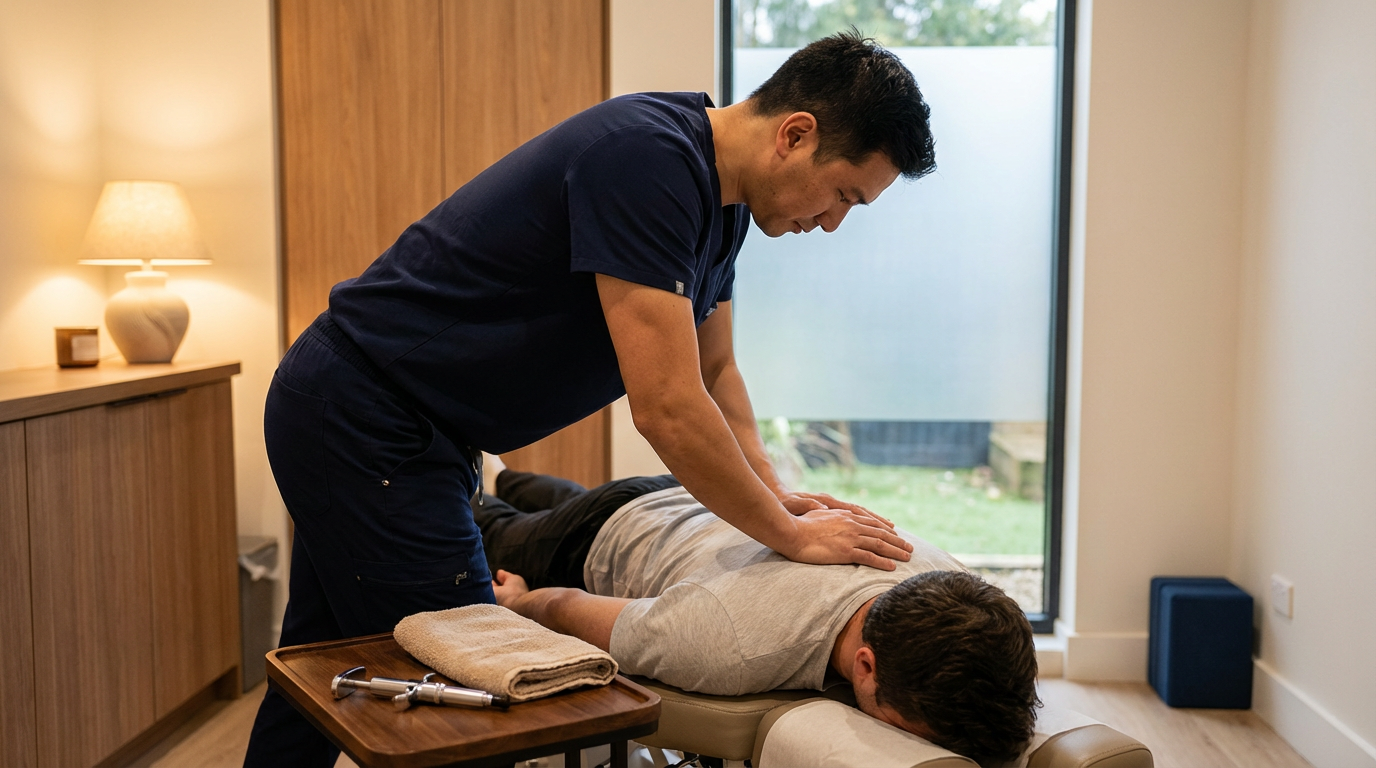
You Do Not Have to Be in Severe Pain to Benefit From an Evaluation
Many people wait until discomfort begins interfering with work, exercise, sleep, or everyday activities.
Earlier signs worth paying attention to may include:
Neck or shoulder tension that builds throughout the workday
Stiffness when standing after sitting
Headaches that appear to begin around the neck or base of the skull
Difficulty turning your head comfortably in one direction
Aching or tension between the shoulder blades
Frequently shifting positions to remain comfortable
Tingling or numbness in the arms or hands
Discomfort that makes it difficult to sleep or fully relax
Persistent numbness, tingling, or weakness should be discussed with a qualified healthcare provider.
We Start by Understanding Your Day, Not Just Your Symptoms
Many people wait until discomfort begins interfering with work, exercise, sleep, or everyday activities. Two people can experience similar symptoms for very different reasons.
That is why our process begins with understanding your work, routines, movement habits, health history, and goals—not simply identifying where it hurts.
STEP 1 WE LISTEN
We ask about your workday, workstation, movement habits, history, symptoms, and goals.
What your body does for 40 hours each week can tell us a great deal about the demands being placed on it.
STEP 2 WE EVALUATE
Dr. Rhett evaluates joint movement, muscular tension, mobility, and relevant movement patterns to better understand where restrictions may be present and how your body may be compensating.
STEP 3 WE EXPLAIN
We explain what we found, what it may mean, and whether we believe chiropractic care is appropriate for you.
You should leave with a clearer understanding of your body—not a list of unexplained medical terms.
STEP 4 WE BUILD A PLAN TOGETHER
When appropriate, your personalized care plan may include chiropractic adjustments, soft-tissue techniques, mobility or strengthening recommendations, and practical guidance for your workstation and daily routine.
Your plan will be based on your evaluation, schedule, comfort level, and goals.

A Conversation Comes First
Your first appointment begins with a conversation.
We will discuss your history, your workday, what brought you in, and what you would like to improve. Dr. Rhett will then complete an appropriate physical evaluation and explain what he finds.
You will have time to ask questions, understand your options, and discuss the recommended next steps.
Appointments at Vital Roots are not rushed.
Some Symptoms Require a Different Kind of Care First
Chiropractic care may be appropriate for many sources of neck and back discomfort, but it is not appropriate for every situation.
Seek prompt or emergency medical evaluation if you experience:
A sudden, severe headache unlike one you have experienced before
New or progressive weakness, numbness, or loss of coordination
Loss of bladder or bowel control
Numbness around the groin, genital area, or inner thighs
Pain following a serious fall, collision, or head injury
Fever accompanied by significant neck stiffness
Unexplained weight loss alongside persistent pain
Chest pain, difficulty breathing, confusion, or loss of consciousness
Part of responsible care is recognizing when another healthcare provider or emergency service is more appropriate.
If your evaluation indicates that your condition falls outside our scope of care, we will explain that clearly and recommend the appropriate next step.
-
Most patients cannot completely restructure how they work, and they may not need to.
Our approach focuses on helping your body better tolerate the demands of your work while identifying practical changes that can realistically fit into your day.
-
Every patient is different.
Your timeline may depend on how long your symptoms have been present, what is contributing to them, your overall health, and how consistently you follow your care plan.
After your evaluation, Dr. Rhett will discuss expectations based on your specific situation rather than providing a generic timeline.
-
Posture is influenced by movement, strength, mobility, habits, environment, and many other factors. It is not simply a fixed position that is permanently “good” or “bad.”
Many people can improve how comfortably they sit, stand, and move through consistent changes in their habits and physical capacity.
-
No. You can contact Vital Roots directly to schedule an appointment.
-
No.
Your recommended care plan will have a defined purpose based on your evaluation and goals. Some patients later choose periodic wellness visits because they feel those visits support their lifestyle, but continued care is always a personal decision.
-
We will tell you.
Headaches can have many causes. Our responsibility is to determine whether your symptoms appear consistent with something chiropractic care may appropriately address and to recommend another type of evaluation when necessary.
-
A standing desk can help introduce more variety into your workday, but standing in one position for eight hours may create a different set of challenges.
The greatest benefit usually comes from changing positions regularly rather than replacing one prolonged position with another.

You Do Not Have to Accept Discomfort as Part of Your Job
Let’s take the time to understand what may be contributing to your discomfort and build a plan that fits your work, your goals, and your life.