

Everyday Movement Should Not Feel This Difficult
Getting out of the car. Reaching a top shelf. Standing up after a movie.
When stiffness or discomfort begins shaping what you do and how you do it, it is worth taking the time to understand why.
You May Have Adapted More Than You Realize
Stiffness has a way of becoming background noise.
You turn your entire body instead of your head. You take the stairs a little differently. You stop reaching for certain things. You avoid sitting too long because you know standing back up will be uncomfortable.
None of these decisions may feel significant on their own. Together, they can gradually change what your day looks like and what you feel comfortable doing.
Some physical changes occur as we age, but persistent stiffness or discomfort should not automatically be dismissed as an unavoidable part of getting older.
Stiffness can have many possible contributors, including reduced mobility, prolonged inactivity, previous injuries, arthritis, nerve irritation, muscular tension, or an underlying medical condition.
These concerns do not all have the same solution.
Care begins by understanding your symptoms, how they affect your daily life, and whether chiropractic care is appropriate for what you are experiencing.
What We Look at Most Closely
-
Sciatica describes a pattern of symptoms involving the sciatic nerve or the nerve roots that contribute to it.
Symptoms may begin in the lower back or buttock and travel down one leg. They may include sharp or burning pain, tingling, numbness, or weakness.
Unlike general lower-back discomfort, sciatica commonly travels into the leg. However, not every form of leg pain is sciatica, and several different conditions can create similar symptoms.
An evaluation helps determine whether your symptoms appear nerve-related, whether chiropractic care may be appropriate, and whether imaging or referral to another provider is needed.
-
Arthritis is a broad term that includes many different conditions affecting the joints.
Osteoarthritis commonly involves changes within the joint that develop over time and may contribute to pain, stiffness after inactivity, swelling, or reduced movement. Other types of arthritis may involve inflammatory or autoimmune processes and require medical management.
Chiropractic care cannot reverse arthritis or restore structural changes within a joint.
For some patients, conservative care may help address surrounding muscular tension, mobility limitations, or other musculoskeletal concerns affecting comfort and function. The approach must reflect the type of arthritis, its severity, your overall health, and the recommendations of any other providers involved in your care.
-
Limited mobility means that a joint or region of the body is not moving as comfortably or freely as it once did.
This may affect the neck, spine, shoulders, hips, knees, ankles, or other joints. Possible contributors include previous injury, prolonged inactivity, arthritis, pain, muscular tension, or changes in strength and movement habits.
When one area becomes uncomfortable or restricted, people may begin changing how they move through surrounding areas.
Our goal is to understand the pattern rather than assuming the location of the restriction automatically reveals its cause.
-
Muscular tension can be influenced by activity, workload, stress, sleep, strength, mobility, previous injury, and movement habits.
Sometimes a muscle becomes tense while attempting to protect an uncomfortable area. In other situations, repeated demands or prolonged positions may contribute to the pattern.
If the same tightness repeatedly returns despite stretching, massage, or rest, it may be helpful to evaluate what else could be contributing to it.
-
Joint discomfort may feel like aching, tenderness, stiffness, swelling, catching, or difficulty moving through a particular range.
Some people notice it more in the morning, after remaining still, or during specific activities. The symptoms may originate within the joint or be influenced by surrounding muscles, connective tissues, nerves, or movement patterns.
A joint that becomes suddenly hot, red, significantly swollen, or extremely painful may require prompt medical evaluation rather than chiropractic care.
Common Contributing Factors
FACTOR 1
REDUCED MOVEMENT
Long periods of limited activity may contribute to stiffness, reduced physical capacity, and less confidence moving through certain positions.
As movement becomes uncomfortable, people may move even less, creating a cycle that can become increasingly difficult to interrupt.
FACTOR 2
PREVIOUS INJURIES
An old injury may continue to influence how you move even after the original tissue has healed.
You may shift weight away from one side, avoid a certain position, or rely more heavily on another part of your body without consciously realizing it.
Those adaptations can sometimes contribute to ongoing stiffness or discomfort.
FACTOR 3
PROLONGED INACTIVITY
Periods of reduced movement may occur because of work, illness, injury, travel, caregiving responsibilities, or changes in routine.
Over time, the body may become less accustomed to movements and activity levels that once felt normal.
Returning to activity gradually and appropriately can be an important part of rebuilding comfort and physical capacity.
FACTOR 4
AGE-RELATED OR DEGENERATIVE CHANGE
Changes in joints, discs, and other tissues become more common with age.
However, the presence of degeneration on an X-ray or MRI does not automatically mean that it is the sole cause of your symptoms. Degenerative findings are also frequently found in people who are not experiencing pain.
Imaging results should be considered alongside your health history, symptoms, physical examination, and daily function.
FACTOR 5
NERVE IRRITATION
When a nerve or nerve root becomes irritated, symptoms may appear somewhere other than the source of the problem.
For example, irritation involving the lower back may contribute to pain, tingling, numbness, or weakness extending into the leg.
Neurological symptoms require careful evaluation because some patterns are appropriate for conservative care while others require medical imaging, specialty care, or urgent evaluation.
FACTOR 6
PROTECTIVE MUSCLE GUARDING
The body may create tension around an area that feels painful, unstable, or vulnerable.
This response can be useful immediately after an injury. When it continues for an extended period, however, it may contribute to stiffness and make normal movement feel more difficult.
The goal is not simply to force a tense muscle to relax. It is to understand why the body may be protecting the area.
FACTOR 7
UNDERLYING HEALTH CONDITIONS
Stiffness and joint pain can sometimes be related to inflammatory arthritis, infection, autoimmune disease, osteoporosis, medication effects, or other health conditions.
Responsible care includes recognizing when symptoms do not fit a typical musculoskeletal pattern and referring patients for appropriate medical evaluation.
Patterns Worth Evaluating
Consider scheduling an evaluation if you notice:
Morning stiffness that regularly takes time to improve
Difficulty with everyday movements that used to feel easy
Pain, tingling, burning, or numbness traveling into an arm or leg
Stiffness after sitting or lying down
A meaningful reduction in your range of motion
Recurring tension that repeatedly returns to the same area
Avoiding activities or movements without consciously deciding to
Difficulty turning your head while driving
Trouble bending, reaching, getting dressed, or getting out of a chair
Discomfort that interferes with sleep, exercise, work, or family activities
Symptoms that are becoming more frequent or intense
You do not have to wait until pain becomes severe or completely limits your activity.
An evaluation can help clarify whether your symptoms appear appropriate for chiropractic care or whether another type of healthcare provider should be involved.
Understanding the Source Before Addressing the Symptoms
Two people can describe the same area of discomfort while experiencing it for entirely different reasons.
Our process begins by understanding your symptoms, daily routines, health history, movement, and goals before making any recommendation for care.
STEP 1
WE LISTEN
When did your symptoms begin? What makes them better or worse? Have they changed over time?
Most importantly, what are you no longer doing—or no longer doing comfortably—that you would like to return to?
Understanding how your symptoms affect your life gives us more useful context than simply asking you to select a number on a pain scale.
STEP 2
WE EVALUATE
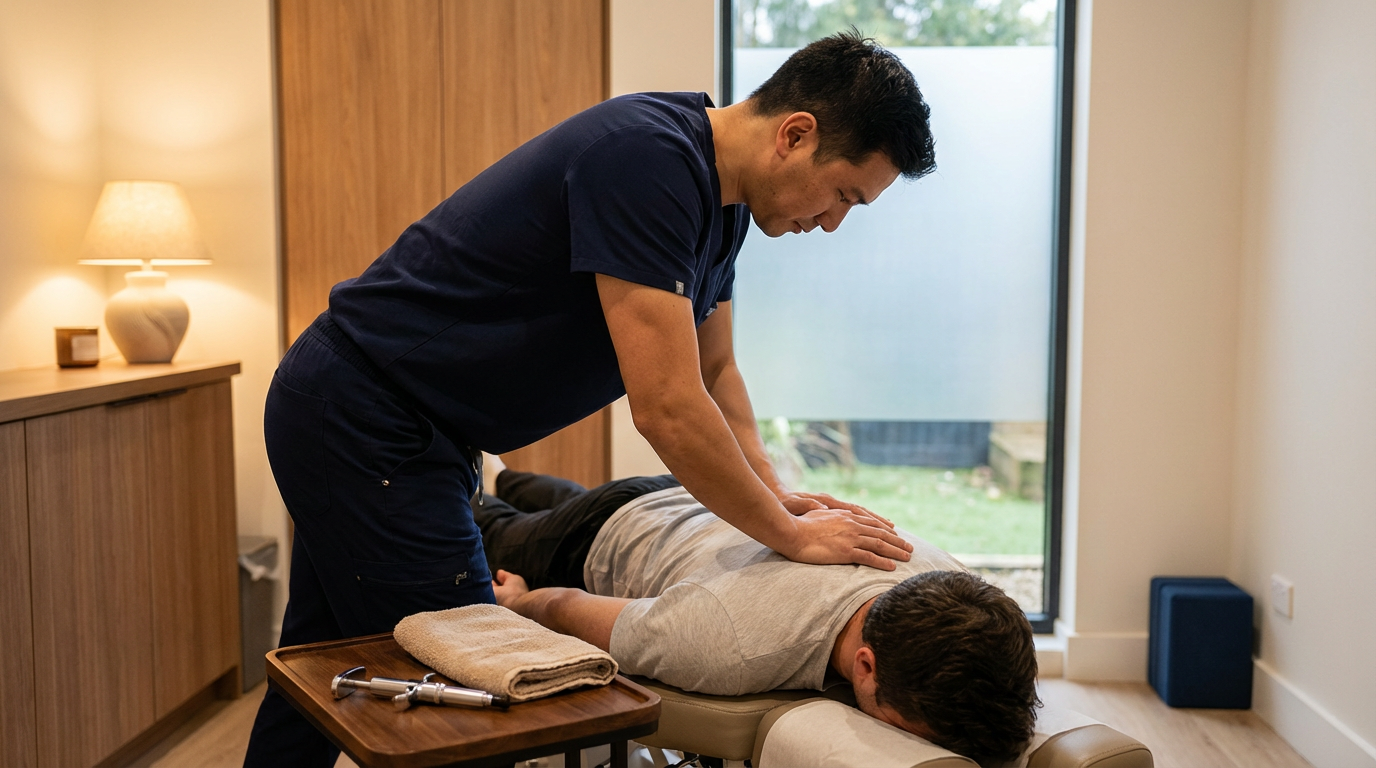
Dr. Rhett evaluates relevant joint movement, muscular tension, range of motion, neurological signs, and functional movement patterns.
The evaluation is adapted to your health history, symptoms, physical ability, and comfort level.
If your findings suggest that imaging, laboratory testing, medical evaluation, physical therapy, orthopedic care, or another type of service is appropriate, we will explain that before proceeding.
STEP 3
WE EXPLAIN
You will receive a clear explanation of what we found, what those findings may mean, and whether chiropractic care appears appropriate.
If your symptoms involve arthritis, degenerative changes, a long-standing condition, or another concern that cannot simply be “fixed,” we will be honest about what care may and may not reasonably accomplish.
You should understand your options before making a decision.
STEP 4
WE BUILD A PLAN TOGETHER
When appropriate, your personalized plan may include chiropractic adjustments or joint-mobilization techniques, soft-tissue care, mobility or strengthening recommendations, and practical guidance for incorporating more comfortable movement into your day.
Techniques are selected based on your evaluation, diagnosis, health history, bone health, comfort level, and goals.
Not every patient requires the same type of adjustment, and some patients may not be appropriate candidates for spinal manipulation at all.

Tell Us What Your Symptoms Are Keeping You From Doing
Your first visit begins with a detailed conversation about your symptoms, health history, routines, and goals.
Please bring any relevant information you have, including:
Previous X-rays, MRI reports, or other imaging
Records from previous healthcare providers
A list of current medications
Information about diagnosed arthritis, osteoporosis, or other health conditions
Details about previous injuries or surgeries
Be prepared to describe not only where you feel discomfort, but also how it affects your daily life.
Can you turn your head comfortably while driving? Get up from the floor? Reach overhead? Walk the distance you want to walk? Sleep without repeatedly changing positions?
These details help us better understand your current function and what you would like to improve.
After the evaluation, Dr. Rhett will explain the findings, answer your questions, and discuss your options before care begins.
If you have concerns about adjustments or particular treatment techniques, please raise them. Your comfort, understanding, and consent are part of the process.
Some Symptoms Require Urgent Evaluation First
Call 911 or seek emergency medical attention if you experience:
New loss of bladder or bowel control
Difficulty beginning urination or an inability to urinate
Numbness around the groin, genitals, buttocks, or inner thighs
New or progressive weakness in one or both legs or arms
Loss of coordination, balance, or the ability to walk normally
Severe pain following a significant fall, collision, or other injury
Back pain accompanied by fever, chills, or feeling seriously unwell
Persistent pain accompanied by unexplained weight loss
New severe pain with a history of cancer
A joint that becomes suddenly hot, red, significantly swollen, or extremely painful
Sudden, severe symptoms that are rapidly worsening
These symptoms may indicate a condition that requires emergency or prompt medical evaluation.
Chiropractic care is not a substitute for emergency care, treatment of an infection, fracture management, or evaluation of a serious neurological condition.
-
Some physical changes become more common with age, but persistent stiffness can have many possible contributors.
Age alone does not tell us what is causing your symptoms or whether anything can be done to improve your comfort and function.
If stiffness is limiting your movement or changing how you live, it is worth having it evaluated rather than automatically accepting it as inevitable.
-
Chiropractic care cannot reverse arthritis or restore cartilage that has been lost.
Depending on the type and severity of arthritis, conservative care may help some patients address surrounding muscular tension, mobility limitations, or other musculoskeletal concerns.
Exercise, strength, mobility, weight management when appropriate, and medical care may also be important parts of managing arthritis.
Dr. Rhett will discuss what appears realistic and whether chiropractic care should be included in your broader care plan.
-
Osteoporosis, previous fractures, certain medications, advanced degeneration, and other health conditions can affect whether particular manual techniques are appropriate.
Please share your complete health history before receiving care.
Dr. Rhett will evaluate whether chiropractic treatment is appropriate, whether the technique should be modified, or whether medical clearance, imaging, or referral is needed.
A gentler technique should not automatically be assumed to be appropriate without an evaluation.
-
Sciatica often involves pain that begins in the lower back or buttock and travels down one leg. Tingling, burning, numbness, or weakness may also be present.
However, several conditions can create similar symptoms.
An evaluation is needed to determine whether your symptoms appear related to sciatic-nerve irritation or another source.
-
The length of time you have experienced symptoms can influence your care plan and expectations, but duration alone does not determine what is possible.
An evaluation can help determine what may be modifiable, what requires ongoing management, and whether another provider should be involved.
We will not promise to reverse a long-standing condition, but we will give you an honest assessment of your options.
-
Stretching may be useful when a muscle or joint would benefit from gradually improving flexibility.
However, stiffness can have many possible causes. If an area is irritated, unstable, inflamed, or protecting another structure, repeatedly stretching it may provide little benefit or may aggravate your symptoms.
The appropriate recommendation depends on what is contributing to the stiffness.
-
Degenerative findings become increasingly common with age and may also appear in people who have no pain.
Your imaging still matters, but it should not be interpreted in isolation.
Dr. Rhett will consider the imaging alongside your symptoms, physical evaluation, health history, and current function to determine whether the findings appear relevant to your care.
-
No.
Any recommended care plan should have a clear purpose based on your evaluation, symptoms, and goals.
Some patients receive care for a defined concern over a limited period. Others later choose periodic wellness visits because they feel those visits support their mobility and lifestyle.
Ongoing care is a personal decision, not a requirement.

Let’s Find Out What Is Actually Going On
An honest evaluation and a clear explanation are where every plan at Vital Roots begins.
Let’s take the time to understand what may be limiting your movement and determine the most appropriate next step.